How to Exist in the Online TTC Community Without Losing Your Own Mind

By: Erica Ferraro

Let’s face it, support groups can either be a blessing or a curse. The “trying to conceive” (TTC) is intimately familiar with this truth. Since embarking on our journey to parenthood, I’ve immersed myself in a myriad of online support groups, vibrant Facebook communities, engaging Instagram conversations, and more. They’re all mesmerizing in their own right. Yet, within their allure, a delicate equilibrium is crucial. Just as in real life, maintaining balance is paramount. Drawing from my own extensive experience as a seasoned traveler within this realm of the hopeful, desolate, anxious, raw, indignant, bewildered, and wounded, I’d like to share with you a collection of tried-and-true strategies and principles. These insights will enable you to extract the utmost benefit from the online TTC community while nurturing your mental well-being in the process.

  1. Recognize that not all that glimmers online is genuine.
    • This pertains to the couple struggling to conceive who appears to have it all figured out, or the family that has welcomed their bundle of joy, projecting an image of utter perfection. Across all scenarios, it’s imperative to grasp that social media merely showcases the highlights of someone’s day. Beneath the surface, we all experience disagreements with our partners, moments of stress, lapses into despair, days where we’re dressed as if we’ve taken residence on the streets, and homes that are gloriously imperfect and messy. This is the essence of being human. You, in your entirety, are flawless just as you are.
  2. Bear in mind that the TTC community harbors profound wounds and, candidly, a sense of resentment.
    • Amid the embrace of supportive and remarkable digital companions, it’s crucial to acknowledge that our convergence stems from a shared narrative that isn’t always born from joy. Your fellow TTC companions carry their own triggers and potentially traumatic experiences. The journey is marked by an array of medications and hormonal fluctuations that can sway emotions. Take care not to over analyze the words and actions of others. The path through infertility is a roller coaster, and at times, individuals might project these emotional fluctuations.
  3. However, it’s important to set a boundary with anyone whose interaction intensifies your anxiety or distress about your personal voyage.
    • The tools of muting, deleting, and blocking are invaluable instruments and ought to be wielded when a connection proves detrimental to your mental equilibrium. If someone consistently inundates you with hurtful messages, demonstrates a lack of support, or persistently engages in disputes centered around fertility topics, remember that you possess every right to sever this link. Our shared struggles should not serve as an excuse for rudeness or disrespect.
  4. Diversity defines the handling and navigation of IVF and the accompanying trauma of infertility.
    • And that’s perfectly acceptable. Our most potent contribution is in supporting our digital sisters in their chosen paths of processing the grief entwined with the journey through infertility.
  5. Infertility isn’t contagious.
    • Avoid plunging into the mental trap of contrasting another’s setbacks against the potential for your own success. Most individuals experiencing triumphant IVF outcomes aren’t perpetually online sharing their tales; they’re living their dreams in the tangible world. I’ve observed that those who do share online tend to be those who’ve encountered prolonged IVF challenges or a more arduous route toward their longed-for miracle. It’s remarkably easy to be engulfed by pessimism and negativity regarding your own voyage. If certain content leaves you feeling excessively despondent, it might be prudent to mute that account.
  6. Understand that treatment protocols vary for valid reasons; heed your physician’s guidance.
    • While I firmly advocate for active involvement in one’s healthcare, it’s crucial to comprehend that a choice like Lauren’s cousin’s friend opting for a Lupron flare doesn’t necessitate that the same approach will suit your antagonist protocol for egg retrieval. Lauren’s cousin’s friend may have different medical circumstances, age, BMI, or other factors unique to her. Information and awareness are invaluable, but the peril of comparison should be evaded. Question your doctor but don’t inundate yourself with comparisons.
  7. Never forget, these individuals remain strangers.
    • Despite feeling a profound connection with the fellow warriors you encounter on the virtual landscape, exercise caution in divulging personal details, including your home address, unless you’ve established direct communication through speaking, video chats, or calls. Online deception and scams are real, obligating you to exercise sound judgment when connecting with online acquaintances.
  8. Occasionally, these strangers blossom into true, real life friendships.
    • Remarkably, some of the women I engage with on a daily basis, who’ve evolved into genuine friends in my real life, emerged from the matrix of the online infertility community. Such beautiful connections can indeed materialize.
  9. Stay abreast of TTC terminology!
    • The longer you remain engaged in these support groups and virtual discourse platforms, the more fertility-related acronyms you’ll encounter. If you find yourself in need of a little assistance, my article, Infertility Acronyms for the Newbies, catalogs the most frequently used acronyms.
  10. Prioritize your own well-being.
    • Ultimately, if engaging with the online TTC community becomes a source of heightened stress rather than support, exercise the prerogative to establish boundaries. Perhaps you choose to follow only those fellow warriors with specific conditions or diagnoses that resonate with your journey. Alternatively, you might decide to nurture some of these virtual bonds further, progressing to in-person or virtual meetups. Your focus should revolve around what best aligns with your needs, and you should harbor no guilt in seeking what brings you inner tranquility.

Finally, a bonus tip: Acknowledge and embrace the inevitable transformation of multiple infertility accounts into narratives of pregnancy. The objective of infertility treatments is, of course, to embrace parenthood. Those who’ve dedicated immense effort to achieve pregnancy may not unfailingly affix “trigger warning” to each post or withhold their joyous accomplishments. Such an expectation would indeed be unrealistic. If we cannot celebrate the successes of our fellow infertility companions, then who can we truly celebrate for?

However you ultimately welcome your precious child, may you discover within the remarkable TTC community all the camaraderie, love, and support it so profoundly offers. Subsequently, I hope you’re inspired to extend this benevolence either forward or back to others who stand in need of it.


How to Not Intentionally Be a Jerk and Support Your Infertile Friends

By: Erica Ferraro

Usually I direct my articles towards my IVF sisters who are currently in their own infertility battle but today, this sentiment is for our well-intentioned friends and family members who need a little help in the sensitivity department. I will preface this by saying that I believe 99% of the time, loved ones really do mean well, they just do not have the context and capacity to understand a struggle so foreign to their own experience.

When in doubt, the best way to support your infertile friend and maintain a healthy relationship with them through their struggle is simply by asking them – “how can I best support you right now, what do you need from me?” Remember, going through an infertility battle is not only hard, long, expensive, physically painful and mentally exhausting but it’s often described as unfathomable. This has recently become my favorite word to describe a battle with infertility; unfathomable. The concept that this is happening to your friend, their partner, their family, and their life is really hard for them to grasp, accept, and understand. I credit this to a society that raises children to be more terrified of teen pregnancy than how to observe, communicate and advocate for common health conditions that could prevent infertility in the first place. The lack of balance between preventing unwanted pregnancy and protecting future fertility is not part of main stream culture and is counter intuitive to truly understanding fertility odds and the reality that 1 in 6 couples struggle to conceive.

Infertility does not need to result in loss of relationships. Just because your friend cannot conceive right now, or without assistance, and you can, does not mean you cannot connect with each other. It may take a little extra work, creativity, and compassion but, if you really love your friend, you can help them weather this storm and come out stronger, together! You both want the same thing, and you can both support each other in your unique paths to motherhood.

So with that context, here is my list of “do not say” to your infertile friends, especially if you love them and want to make them feel better during their hardship.

  1. Everything happens for a reason
    • This is harmful to those struggling to get pregnant because it’s hard to justify why horrible things happen to one person, and do not for the next. Maybe there eventually will be a “bigger reason” for all of your friend’s hardship but, there also might not be and so, it’s better to say “It is not fair that you are struggling. We are all dealt our own cards, and I commend you for handling yours the way that you are. No matter what happens, you will always be a valuable friend/person in my life and in the lives of others.”
  2. I know a couple who did X, you should try that
    • If you’re not a doctor, please do not offer unsolicited medical advice. Most of the “woo-woo” stuff we hear about on the internet, in support groups, and through others, are not backed by scientific evidence and causes more harmful mental spiraling than helps provide a solution. Each couple is unique in their infertility diagnosis and no two protocols are the same. Trust me, if you (someone outside of the TTC community) have heard of something that your infertile friend should try, I can guarantee they have already heard it, spiraled about it, and talked to others about it. Instead, you can say “I am proud of you for advocating for what you and your partner think is best and working closely with your doctor to develop the best plan for you! Keep fighting the good fight.”
  3. Relax
    • There is no amount of relaxing, vacations, red wine, or wild sex that is going to get your friend pregnant if they have a medical diagnosis as to why they are infertile. Relaxation doesn’t create quality sperm and eggs, it doesn’t fix hormone or thyroid levels, it doesn’t unblock fallopian tubes. Hence, we shouldn’t say it. This sentiment implies that your friend is responsible for their infertility by not appropriately handling their emotions, and that’s just not true. Instead, “How can I help you ease your mind and relax a little? I am sure you’re stressed out of your mind and I’d love to help you breathe a bit easier.”
  4. When its your time it’ll happen
    • This is insensitive simply because we all hope and dream about certain milestones and timelines for our lives and usually, its not the infertile friends going through an IVF cycle who aren’t “ready.” Actually, these are the most ready and “ripe” of the bunch, as they have had the most time to plan, think, and intentionally try to start a family. Saying that it’s just “not their time” is cruel, because none of us have control over this stuff. Also, why was it your time instead of theirs? Again, it’s hard to justify things that are out of our control and are truly, a luck of the draw. Instead try, “Its extremely unfair that this is happening to you, how can I support you better?”
  5. Once you give up, it’ll happen spontaneously
    • This isn’t true. Plain and simple. If you have a medical infertility diagnosis, “giving up” means your friend will continue to not get pregnant.. because again, they have a medical diagnosis. Instead try: “When you do become a mom, you’re going to be one of the best. Until then, I am here for you and love you nonetheless. “
  6. Why don’t you just adopt?
    • Because it’s not “just” adopting: Adoption is COSTLY, can take years, and is a completely different path to parenthood that your friend may not want or feel comfy with yet. Adopted children are not consolation prizes to infertility.
  7. You’ll love IVF because you can pick the gender and have twins
    • A great misconception is that IVF equals twins and gender selection, and both, are not always true. No one loves IVF, even if it seems like there is a perk to the process from an outsider’s point of view. Actually, twins are less likely due to advancements in science and medicine with a focus on forcing less high risk pregnancies.
  8. Congratulations!
    • No. Please just don’t say this to anyone. IVF is not a happy reality for those who need to venture down this path. It may result in happy times, eventually, but, it’s not the road anyone wants to have to take. Instead, go with “I know this isn’t how you imagined becoming a mother. I will be here for you every step of the way.”
  9. I’m so glad I don’t have to do IVF, I don’t know how you do it/I couldn’t do it.
    • You’re incredibly lucky you don’t have to. You’d be surprised what you are willing to do, when you do not have other options. Unless you are required to make that choice to have a family, you really can’t know what you would or wouldn’t do. Instead try, “I am proud of you for making the tough decision to move forward with IVF, it requires a special level of strength and determination to make hard decisions.”
  10. It will all be worth it
    • It might be, it also might not be. IVF is not a catch-all for infertility, and it doesn’t work for everyone. Many couples leave IVF without a baby, insurmountable debt, a slew of irreversible mental health issues, lost relationships, and may other negative outcomes. Sometimes, even a baby, isn’t worth all of that. Instead say “Every step you take, is one step closer to your goal and until then, I am here. Outcome or not, your value as my friend has not changed and I will love you regardless.”

As someone who has endured years of infertility and failed treatments, I can confidently say that infertility can bring you closer to your friends and loved ones, just as easily as it can create a wedge. I hope that if you are the infertile friend, or the fertile friend, you can find a way to support one another and be kind; the journey to motherhood is unique for everyone and we can all use a little validation, empathy, and support.

Thoughts from a DOR Girl: You Have Options, Even Though it May Not Feel That Way

By: Erica Ferraro

Ah, diminished ovarian reserve (DOR), one of the leading silent culprits behind female infertility. A condition so discreet, it can remain undiagnosed throughout a woman’s entire life unless she seeks help from a fertility clinic.

DOR reveals itself when a woman’s egg quantity, and often quality, fall short of what is expected for her age. While all women will eventually experience a natural decline in egg reserve with menopause, the medical diagnosis of DOR occurs outside the realm of menopause. To delve deeper into the intricacies of DOR, its diagnosis, and comprehensive information about this condition, don’t miss my article here.

DOR has, without a doubt, proven to be one of the cruelest, most unfair, expensive, and heart-wrenching causes of infertility. Imagine the daunting reality of not having enough high-quality eggs to create embryos—a challenge that can shatter the hopes of anyone yearning to become a parent. This reality becomes especially pronounced the younger you are, as the connection between egg quality and age looms large. Aging affects women differently from men, as women do not continuously generate new eggs the way men regenerate their sperm. Consequently, older women face higher rates of miscarriage due to declining egg quality and the formation of abnormal embryos. This reality, heart-breaking as it is, becomes less shocking to women of progressed age, whereas their younger counterparts confront a devastating blow upon receiving a DOR diagnosis. I know this all too well—I was diagnosed at 29 years old through a blood test, which revealed my Anti-Müllerian hormone (AMH) level was 0.9, coupled with just five follicles across both ovaries. To put this into perspective, a close friend of mine, the same age, recently had her AMH tested, showing a level of 4.75, with 29 follicles across both ovaries. She has experienced two spontaneous, unplanned pregnancies, while I have had none despite tracking ovulation and engaging in timed intercourse for two years. That, my friends, is the harsh reality of DOR. No one at 29 should be told their egg quality and quantity resemble that of a 45-year-old—yet, here I am. Thanks endometriosis.

In my battle with DOR, I have encountered numerous vigilant, dedicated, resilient, and brave warriors at various stages of their In Vitro Fertilization (IVF) journeys. The sad truth is that DOR often necessitates IVF, often through multiple rounds. Any doctor who insists on Intrauterine Insemination (IUI) for a DOR diagnosis may not be the most suitable fit for you. The reason being, a low egg reserve often corresponds with low egg quality. The only way to ascertain whether healthy embryos can be formed is through the process of IVF, which includes genetic testing. Have I met a few DOR warriors who produced healthy embryos? Certainly! However, I have also encountered plenty, including myself, who, despite multiple rounds of IVF, couldn’t even create one. Such experiences reinforce the importance of IVF and genetic testing, which provides answers to your DOR diagnosis, answers that IUI simply cannot provide. Thankfully, my husband and I were fortunate to work with a doctor who specialized in DOR, and he encouraged us to skip IUI altogether and proceed directly to IVF. We are grateful for that decision, as it allowed us to progress more swiftly and determine our next steps more effectively.

Today’s article does not intend to be a dissertation on DOR. Instead, I aim to focus on the two choices that DOR warriors face—choices that may feel overwhelming, isolating, and downright terrifying. The choices, my dear readers, are these: continue with egg retrievals, hoping to create genetically normal embryos, or explore alternative paths to parenthood. Drawing from my experience and the countless DOR warriors I have connected with online, these choices ultimately hinge on three factors: finances, expectations, and odds. Your unique perspective on each of these factors will guide you toward your next best step.

You are not alone in this journey; let’s explore each factor in detail:

  1. Finances: As one would expect, financial constraints dictate how many rounds of egg retrievals one can undertake. Having insurance coverage can significantly impact the feasibility of multiple egg retrievals. However, it is crucial not to take what your clinic says at face value. Take the initiative to call your insurance provider directly and request comprehensive information on coverage. Clarify the distinction between your medical and pharmacy benefits to make informed decisions. Understanding these aspects can make a world of difference in deciding your best plan forward. I know a close friend whose clinic initially claimed she would pay out-of-pocket for services. Yet, after following up with her insurance provider, she discovered they were in-network, and costs should have been covered. Needless to say, she is now in litigation with the clinic, which wrongly charged her out-of-network costs. This serves as a valuable lesson—do your homework and ask in-depth questions of your insurance provider.
  2. Expectations: This category branches into two realms: expectations for your future family and expectations for your current life. Every couple’s aspirations differ, and that is perfectly okay. It is essential, however, to confront these aspirations openly with yourself and your partner. Here are some questions to ponder:
    • Future Family Expectations: How important is it to you that your children are genetically related to you? How many children do you desire to have? Do all children need to be genetically linked to you, to each other, or does that matter less to you? How do you define motherhood/parenthood and family? Does it revolve around genetics, or does it encompass a broader sense of connection? What are your partner’s thoughts on these matters?
    • Current Life Expectations: How are you handling the emotional and physical toll of egg retrievals? Have they taken a drastic toll on your body, leaving you uncomfortable with the changes? How is your mental health amid the uncertainties of this season? How many more egg retrievals can you handle mentally, especially if they result in poor outcomes, before it becomes too much to bear? Does the fear of more egg retrieval failures outweigh the prospect of exploring alternative paths to parenthood? At what point does that shift occur? If you cannot easily produce healthy embryos, how many more rounds of egg retrievals are you willing to endure? How do you envision spending the next few months or years of your life? Paint that picture, create a timeline, and sit with it for a while. You may not be able to control your medical diagnosis, but you have the power to shape how you spend your time and preserve your mental well-being.
  3. Odds: This is a topic best discussed with your doctor and then pondered personally. IVF success hinges on odds, based on factors like your medical diagnosis, age, and lifestyle. Your doctor can provide insights into your likelihood of success, but the final decision lies with you. When my husband and I consulted our doctor, we were informed that we had a 30-40% chance of success. As we underwent a few failed egg retrievals and witnessed my AMH levels continue to decline, the odds plummeted to 5%-10%. With natural conception rates hovering around 25%-30% each month of a woman’s cycle, investing a significant sum of money for a lower chance of success didn’t make financial sense to us. We were grateful for the opportunity to try, but we didn’t want to accrue massive debt only to comprehend the risk vs. reward tradeoff for our specific situation. Instead, we chose to channel our funds into an option that offered higher odds of success, which led us to explore the use of an egg donor. For more on this topic, read my article on how to process the idea of using an egg donor here.

Along this journey, I have encountered many DOR warriors who have undergone five, eight, ten, and even an astounding 16 rounds of egg retrieval! Yes, after five years or more of egg retrievals, putting their lives on hold, and amassing a mountain of medical bills, some warriors do achieve their dream of having a genetic child. For them, I have no doubt that every ounce of struggle was worth it. However, for us, we decided that path would not be our own and chose to explore the use of an egg donor after two failed IVF cycles and an unsuccessful PRP therapy. I initially worried that by doing so, I might be “giving up.” Yet, I soon realized that shifting directions mentally is extraordinarily challenging, and it is a process to work through. I also learned that regardless of the choice you make, it will be tough. The key lies in understanding that you HAVE CHOICES, and they extend far beyond being stuck in an endless egg retrieval loop.

During conversations with warriors, I’ve come to understand that feelings of hopelessness and even frightening darkness are not uncommon. Many of us who realize that we cannot create healthy embryos struggle to see light at the end of the tunnel, and suicidal-like feelings are not foreign to this community. So, if you’re reading this now, I hope you understand that YOU possess choices. There are numerous beautiful routes to motherhood, and if egg retrievals aren’t going as planned, it is NOT the end of your story or your future. When the time is right for you, you can pivot, and nobody but you and your partner can determine when that moment comes. This includes your doctor; the decision to pivot or continue rests solely with you. Remember, the choice you make is personal and rests on the three factors discussed above, among others.

I believe in your ability to make the decision that best suits you, your mental health, and your family. I believe in you, and I hope you do too.

Building Our Family, Piece by Piece

A puzzle fundraising idea for IVF families

By: Erica Ferraro

My husband and I embarked on our IVF journey with hopeful hearts, believing it would be a manageable process: an egg retrieval, embryo creation, and a transfer, all leading to the joyous news of pregnancy in just a few months. We felt fortunate to have some insurance coverage, and we knew we were not alone in our dreams of building a family.

To take our first step, I underwent a necessary endometriosis laparoscopy surgery. Though a year has passed, we haven’t yet received the news we long for, but we remain positive and resilient. Along the way, we faced significant financial challenges, depleting our family savings and taking on a loan for donor eggs.

To raise additional funds, my husband and I decided to take up part-time jobs coaching youth sports teams. We also bravely reached out to our community for support, knowing that there were others who genuinely cared about our journey. We came up with a heartwarming idea to fundraise for our IVF through selling puzzle pieces that would eventually form a beautiful artwork for our future baby’s nursery.

Using the Canva app, I created a post to share our fundraiser on social media. The response was overwhelmingly positive, with friends and family showing immense support. We carefully kept track of each generous contribution on an Excel spreadsheet, cherishing every name and the number of puzzle pieces they bought.

The love and support we received were truly humbling, teaching us that it’s okay to ask for help when going through such a challenging medical condition. The puzzle fundraiser turned out to be a beautiful success, with around 500 pieces sold over four months, greatly easing the burden of our donor egg loan.

With the funds raised, we used Canva.com again to find a blank 500-piece puzzle image and typed the corresponding names over the pieces. We printed and framed the puzzle poster through their site. You could also order a blank puzzle, write names on the back of the pieces, use puzzle glue to stick them together as one image and frame it yourself. The Canva idea worked best for us, as putting together a 500-piece puzzle was cumbersome and time-consuming. But this could be a fun activity if you and your partner like to put puzzles together!

Our puzzle now hangs, framed, in our miracle baby’s nursery and was proudly displayed at our baby shower. Throughout this journey, we were amazed that many other IVF warriors also generously supported us. We marked their contributions with a pineapple icon next to their name to acknowledge their own battles. It truly reflects the profound bond among those in the IVF community—a club of resilience and compassion.

Lupron Depot: How to Survive The Devil’s Drug

By: Erica Ferraro

If you’re familiar with Lupron Depot, you’re aware that this drug is not for the faint-hearted. Primarily used in the treatment of female cancer patients, Lupron Depot is also utilized in embryo transfer protocols for women with endometriosis (endo) or adenomyosis (adeno). Endometriosis is an inflammatory disease that, when active, can lead to failed embryo transfers or miscarriages. Adenomyosis is a similar condition typically caused by uterine trauma. Before transferring an embryo, both conditions must be managed and under control, which is where Lupron Depot comes into play. It is prescribed to manage endometriosis by providing pain relief, reducing endometriotic lesions, improving anemia due to vaginal bleeding before fibroid surgeries, treating advanced prostate cancer in men, and addressing central precocious puberty (early puberty in children). Lupron Depot works by suppressing estrogen production in women or testosterone production in men. For endo and adeno patients, removing estrogen from the body allows the endometrial tissue to “calm down” and become dormant, a critical factor in achieving a healthy pregnancy.

The drug is typically administered every three months through intramuscular injections, yes, with a large needle. If you’ve previously experienced PIO shots, Lupron Depot injections will be relatively easier. However, the symptoms associated with the drug are an entirely different story.

I have been on Lupron Depot for the past three months. Recently, I began introducing estrogen pills to prepare for my first embryo transfer, and I am delighted to share that reintroducing estrogen into my body relieved menopause symptoms within 24 hours. Nevertheless, enduring three months without estrogen in my body has been quite an experience, to say the least. It is important to note that this is not the same as regular menopause. Natural menopause occurs gradually over time, with estrogen levels decreasing slowly over months or years, allowing the body to adjust naturally. Medicated menopause induced by Lupron Depot, on the other hand, rapidly removes estrogen from the body within 24 hours of injection, resulting in a sudden and extreme hormonal shift. Therefore, the experience differs from age-related menopause, and the symptoms are much more severe due to this abrupt change.

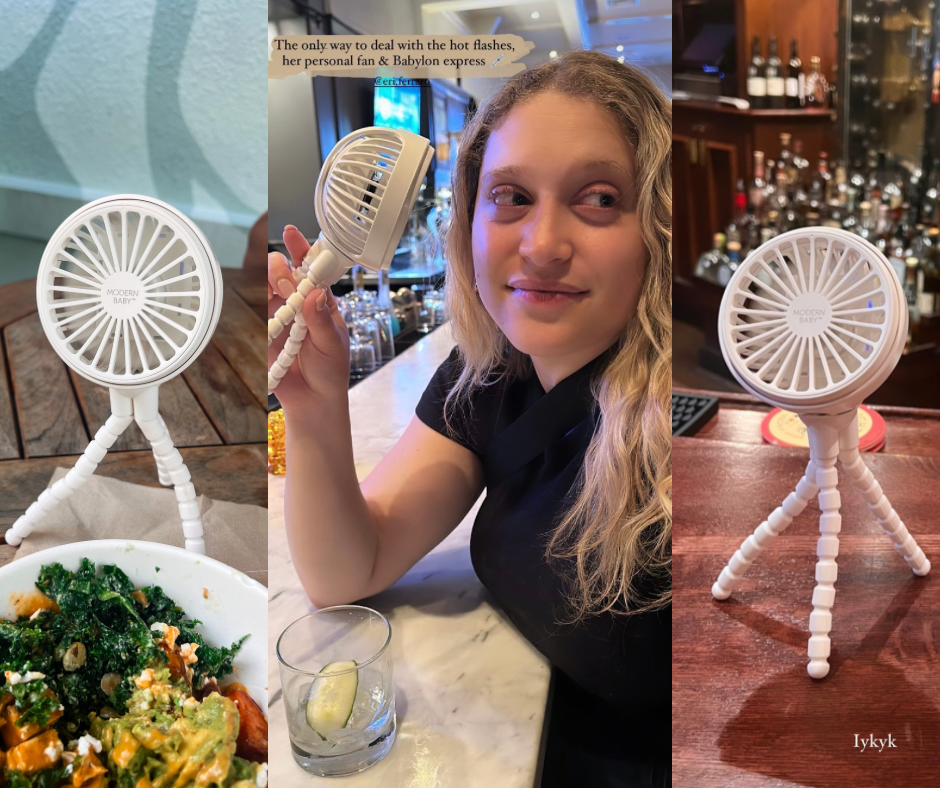
Within approximately five days of receiving my first Lupron Depot injection, I began experiencing intense, life-altering hot flashes about twice an hour, including during the night. These hot flashes were so overwhelming that I had no choice but to shed layers of clothing and pant like a dog on a scorching summer day. I would become breathless from these episodes. To cope with the heat, I relied on a handy portable fan, ironically a baby stroller fan, which I could prop up and use whenever a hot flash occurred. I even brought the fan with me when traveling and propped it up on hotel nightstands to blow cool air on me throughout the night. Although our home has central air conditioning and a large overhead fan in our master bedroom, my frequent work travels and commitments made it necessary to have a source of cool air at my disposal, especially in hotel rooms without ceiling fans. I also considered using a neck fan, which I would definitely invest in if I ever have to undergo Lupron Depot treatment again.

me and my fan, a summer love affair

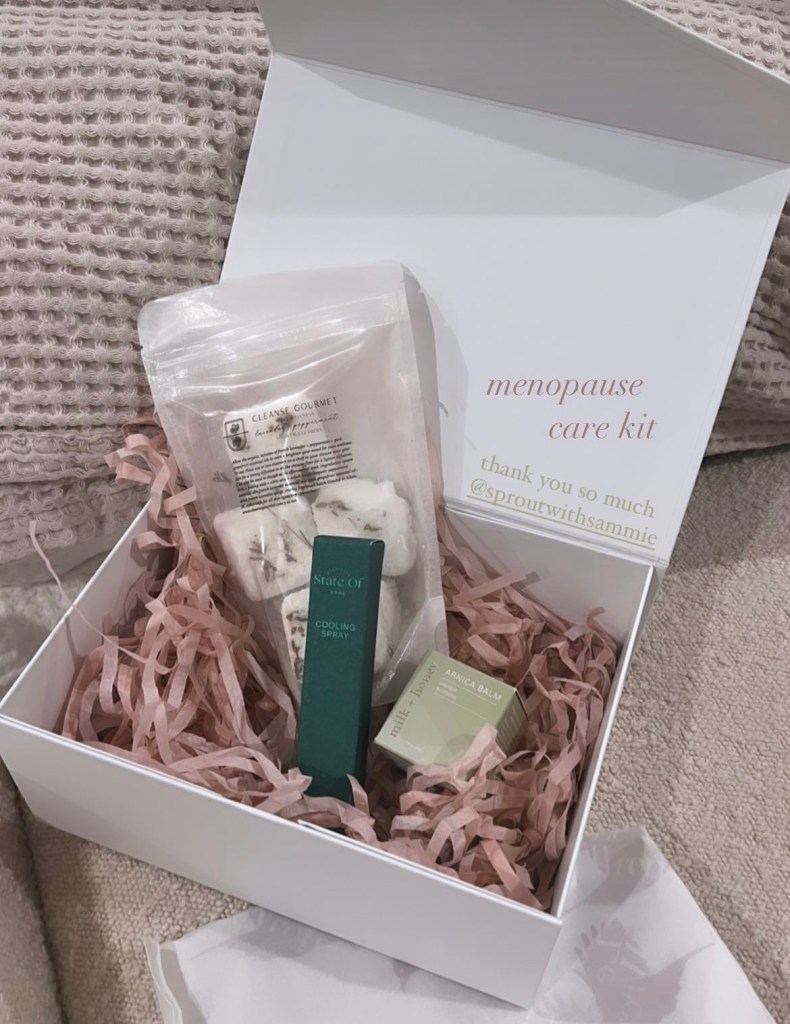
A thoughtful friend gifted me a menopause survival kit that included mint cooling spray, and another sent me peppermint essential oils in a roller ball. These items, along with my Stanley water bottle, helped maintain my sanity. My advice is to find what works best for you and make sure to have a fan nearby while keeping yourself consistently hydrated.

Grateful for the friends who supported my summer of menopause

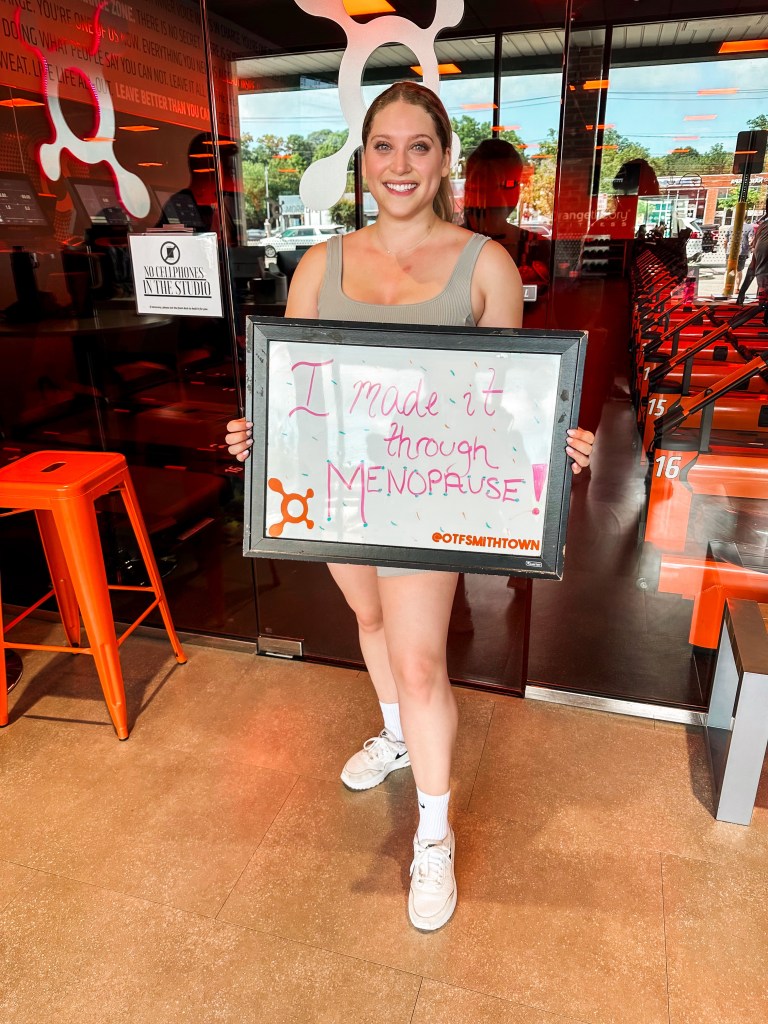
I also noticed that exercise and acupuncture helped alleviate my sweats. On days when I participated in a workout class or had an acupuncture session, I experienced fewer overall hot flashes. However, exercise wasn’t always easy due to the joint pain that is a side effect of Lupron Depot. I managed to stick to a two-day-a-week schedule at Orange Theory Fitness, doing the best I could under the circumstances. I also signed up with my husband and our bestfriends to complete a series of 5k runs at different state parks on Long Island. It was ironic to be so fit while so “sick” but, the determination to keep the hot flashes and weight gain down, kept me pushing through.

My last OTF class while in medicated menopause

Fatigue and hormone headaches were also part of my experience. My doctor allowed me to take Tylenol, which provided some relief. When I felt tired, I made an effort to rest. I was honest with my employer about the medication protocol, and their understanding and flexibility proved beneficial during this time.

Additionally, I faced side effects such as weight gain or water retention and hair thinning. I tried to mitigate these by incorporating exercise, maintaining a healthy diet, and following a strict hair care routine with high-quality products, particularly my favorites from Pureology and Olaplex. I also consulted my doctor about taking a daily calcium supplement while in menopause to counter any potential loss in bone density. Weight-bearing exercises at Orange Theory Fitness and running likely helped mitigate this concern as well.

I completed my first 5K while in menopause.. sometimes we can still surprise ourselves, even during hard times

Overall, Lupron Depot undeniably presented challenges, but I made every effort to fight back. The fluctuating hormones added another layer of difficulty to an already mentally and emotionally draining battle with infertility. I wholeheartedly embraced one-on-one talk therapy and group therapy with fellow IVF warriors, which undoubtedly contributed to my ability to endure the toughest three months of my life.

If you are about to embark on a journey with Lupron Depot, I commend you for your bravery. I acknowledge the hardships that lie ahead and, most importantly, I believe in you. If I could navigate medicated menopause, then I truly believe anyone can.

The 10 Things I Know to be Absolutely Certain About Infertility

By: Erica Ferraro

But I don’t want to go among mad people,” Alice remarked. “Oh, you can’t help that,” said the Cat: “we’re all mad here. I’m mad. You’re mad.”

Alice in Wonderland

Are you feeling the flames of frustration burning within? Feeling a bit…. MAD? In the midst of the uncertainty that defines all infertility journeys, let me present to you a collection of ten certainties—anchors in a sea of doubt.

  1. Nothing you did, didn’t do, or are currently doing will wield a monumental impact on your outcome. Your infertility situation bears no blame, for 99.9% of it lies beyond your control. Remember, infertility is a medical diagnosis.
  2. Infertility is not contagious. Your friend’s triumphs or failures in this realm hold no impact over your own fate. Everyone is different, try not to compare.
  3. According to the World Health Organization, a staggering 1 in 6 couples encounters the challenges of infertility. You are far from alone. Countless others have faced or are currently enduring the hidden struggles of infertility, though they may not own or share their truth as openly as you do. So cast aside any illusions propagated by the picture-perfect pregnancy announcements, family portraits, and incessant stream of baby-centric content invading your feed.
  4. Brace yourself for a whirlwind of emotions that will sweep you away on a tempestuous journey. There is no singular path to navigate this undoubtedly arduous chapter of your life. Embrace the duality within yourself; feeling in control and content one day, then spiraling on the floor the next—both experiences are normal.
  5. Enter the enigmatic realm of infertility, where understanding is as a rare gem reserved for those who have walked this perilous path. Oh, how elusive it is for those fortunate souls untouched by this tumultuous journey! Sympathy may dance at their fingertips, but true empathy remains an enigma beyond their grasp—a distinction so profound that it sets worlds apart. Here, lies the secret to preserving your heart from the snares of disappointment: shun expectations like the shades of night. Embrace this wisdom, and you shall emerge stronger, navigating the intricacies of this labyrinthine experience with a heart unburdened by the weight of unfulfilled hopes.
  6. However, should you encounter a fellow traveler who has tasted the bitterness of infertility, embrace them. Forge connections, intertwine your stories, and bond with those who can genuinely empathize with the hardships you endure. The most exasperating aspect of this journey is the sense of isolation, feeling that no one truly understands the magnitude of your struggle in this season of your life. But fear not, dear warrior, your infertility sisters are here. They are you, and you are one. If you seek inspiration on the importance of supporting others in this resilient community, I implore you to read my article: “Hug Your Infertility Sisters, Literally.”
  7. Unveiling the disheartening truth: infertility clinics are profit-driven entities. Their ultimate objective lies in both making money and aiding you in fulfilling your dreams of building a family. Alas, they might not share your urgency regarding timelines. Instead, their financial interests align with prolonging the journey. This is precisely why active involvement in your treatment is of paramount importance. Educate yourself, seek solace in conversation with others, and attend doctor’s appointments armed with insightful questions. Dare to seek second opinions and present data you have discovered to your reproductive endocrinologist. This is your life, your health, and your finances—assert your right to question, comment, and actively participate in your treatment plan.
  8. Let us shatter the illusion that IVF is the “catch all” for infertility—it is not. Its efficacy varies greatly depending on numerous factors such as age, lifestyle, and medical condition. Familiarize yourself with the success rate corresponding to your unique diagnosis, empowering you to make informed decisions alongside your doctor.
  9. Brace yourself, for infertility will bring about change within your relationships. Some connections may wither under the weight of your hardship, as individuals struggle to connect and recoil from discomfort. Some may be blind to their own privilege, not comprehending the challenges you face. However, do not despair, for others will be profoundly moved and inspired by your unwavering strength, determination, and resilience. Their respect for you will reach new heights. Be grateful for those who stand beside you, and also for those who drift away. Sometimes, it takes a catastrophic life event to unveil who is truly meant to be a permanent presence in your life.
  10. Madness shall embrace you, my dear, but take solace in the words of our whimsical friend, the Mad Hatter from Alice in Wonderland: “If I had a world of my own, everything would be nonsense. Nothing would be what it is, because everything would be what it isn’t. And contrarywise, what is, it wouldn’t be.” Some aspects of life defy reason, yet perhaps they need not conform to our expectations. Infertility, though undeniably unjust, forms a profound and unique bond among warriors like us—a bond transcending age, medical diagnoses, nationality, religion, and socioeconomic status. Not everyone can lay claim to such a profoundly unique experience. So, my dear, even if it deviates from your imagined path, find solace in the beauty of being part of a community united by determination, resilience, empathy, strength, and love.

Lastly, I leave you with this sentiment: what is meant to be will be. The soul destined to find you will do so, in whatever form, shape, or manner. You will become the mother of your dreams, and this predicament will resolve itself, one way or another. Each step you take propels you closer to the path that destiny has woven for you. All the hardships and pain you endure serve as preparation for the extraordinary journey of motherhood—a path unattainable without the level of intention, difficulty, and purpose you embody. Besides, what’s greatness without a little madness?

Embryo Transfer Day Must Have’s

By: Erica Ferraro

Embryo transfer day is one of the most exciting, nerve-racking, and special days you will have in your IVF journey. It is the day that all of your hard work, comes to a climax as you try with all of your might to bring your baby, Earthside. This moment is nerve-racking, because there is no guarantee that an embryo transfer will result in a healthy pregnancy or a live baby. It is one very scary but critical step in your journey to your miracle baby.

Preparing for an embryo transfer is a privilege as it takes a lot of hard work, and for some, multiple rounds of egg retrieval, to prepare for. So if you’ve made it to preparing for an embryo transfer, I commend you. You’ve already moved many mountains!

Bask in the glow of this special time, and treat yourself to a special token or two to make your embryo transfer day just that much more special. There are many IVF Transfer day, shirts and socks online (gotta keep those feet warm!) however I put together a collection of a few that I think are aesthetically pleasing plus some accessories that I think will elevate your experience. All from Amazon!

I’m wishing you all the sticky baby dust in the world! Welcome to your Mom era!

Building Mental Resilience: Tips for Preparing for an Embryo Transfer

By: Erica Ferraro

Embryo transfer anxiety is a real challenge, but let me tell you, you’re not alone. I’ve been on this roller coaster for weeks, preparing for my first fresh embryo transfer. It feels like my entire future and well-being hinge on the success of this transfer. If you’ve gone through the process of creating and preparing to transfer an embryo, you know exactly what I mean.

There are two types of embryo transfers: fresh and frozen. Fresh transfers involve fertilized eggs growing into mature blastocysts and then being transferred into the uterus on day 3, 5, 6, or 7 of development. Day 5 embryos typically have higher success rates, but plenty of women have achieved pregnancy with embryos from other days too. On the other hand, frozen embryo transfers occur when mature embryos are frozen and then transferred later or undergo genetic testing (PGT).

The advantage of a fresh transfer is that it’s more affordable (no PGT costs) and quicker (no waiting weeks for test results). Plus, it gives each embryo a chance to thrive. However, without genetic testing, you can’t be certain if the embryo is normal, which means potential risks of miscarriage cannot be mitigated. With a frozen embryo transfer, you have the advantage of additional time to prepare your body or opt for genetic testing. PGT testing, even for a single embryo, can be expensive. We spent $4500 to test our only embryo, only to find out it was abnormal.

My husband and I are currently preparing for a fresh transfer because we purchased frozen donor eggs due to my endometriosis and diminished ovarian reserve. To avoid compromising the DNA by thawing the purchased eggs and then refreezing the embryos for testing, our doctor advised us to go for a fresh transfer. To be honest, I’m terrified. Not having PGT testing feels like taking a leap of faith, where we have even less control over the situation. But, I’ve met many women in this community who had PGT-normal embryos that didn’t implant or miscarried before 12 weeks. And then of course there are a slew of success stories where embryos were not PGT tested. Recent controversy around PGT testing suggests that it may not always be 100% accurate and that some abnormalities can self-correct in the womb. So, the decision to undergo genetic testing is personal and depends on each couple’s unique situation – there truly is no right or wrong way, just what feels best for you!

Regardless of the route you choose, transferring an embryo is an incredibly stressful experience. It involves a tremendous amount of time, physical pain, mental endurance, and financial investment. The emotional and physical demands of egg retrievals are overwhelming, and the thought of going through more retrieval cycles after finally starting to transfer embryos is alarming.

The pressure to succeed after investing your life’s savings to have a child can feel suffocating. But remember, there are ways to cope with transfer nerves:

  1. The failures of others are not predictive of your own outcome.
    • Each person’s body and medical situation are different, so avoid comparing yourself to others.
  2. Understand that it may take 2-3 embryos to achieve success.
    • Every step forward brings you closer to the child you’re meant to have.
  3. Accept that there are things beyond your control.
    • You’ve done your research and sought advice from experts and fellow warriors. Trust in the process and have faith.
  4. Making it to a transfer is an accomplishment in itself.
    • Reflect on the setbacks, traumas, and hurdles you’ve already overcome. You’ve moved mountains.
  5. You don’t owe anyone specific details about your transfer.
    • Share only if you want to. Protect your privacy and give yourself space to process before sharing.
  6. Lean on your fellow warriors within the IVF community.
    • Connect with others who understand your fears and share in a safe space.
  7. Manifest success and document precious moments.
    • Believe in the power of your transfer. Capture memories that you’ll cherish, regardless of the outcome. Get the damn fries (iykyk)
  8. Keep yourself busy with activities that bring you joy
    • Indulge in the things you love before transfer. No one regrets taking time to prioritize themselves. Especially having that one last glass of wine or sushi date before you’re, hopefully, pregnant!
  9. Prioritize self-care above all else.
    • This journey is profound, and you need to be kind to yourself. Release any guilt and focus on comfort, relaxation, and preparation. Everything else can wait.
  10. What if it doesn’t work?
    • But what if it does?

Bonus tip: If you’re someone who finds comfort in planning (hi, me) use this time to discuss with your partner what plan B and C will look like, should things not go as planned for this transfer. For example, you could approach your partner and say “It would really help my anxiety to discuss what our next steps would be, should this transfer not be successful. Would we go right into another transfer? Try a new protocol? Take time off? Consider alternate routes? Do another egg retrieval? Let’s write down what our contingency plan looks like and get comfy with it, should we need to refer to it.”

Remember, there’s an entire team of fellow warriors who share your fears, tears, and years of dedication. We’re all pushing through the uncertainties and traumas of this journey. It may not feel fair now, but eventually, it will all be worth it. The path is uncertain but the end goal is clear. Stay strong and keep moving forward, one mountain at a time.

So You Need To Use an Egg Donor? How Not to Spiral, Panic, or Jump off a Cliff, By Someone Who Has Contemplated Cliff Jumping, Among Other Things.

By: Erica Ferraro

Wait…What? We have to use WHAT? What in the world is an egg donor? NO WAY! OH MY GOD, this means I’ll never have my children. Are you suggesting that I carry another woman’s baby with my husband’s sperm? Are you out of your mind? But I am only 30 years old…everyone I know has no trouble having their genetic children. Why should I face this? I thought IVF was my savior, the solution to all of my struggles! But now, does that mean I won’t be a proper mother? This can’t be happening. Why me? Are my genetics not worthy enough to be passed on? Will my partner resent me for this? Will my baby hate me? Is my life shattered and done for? Is there any hope left? Should I throw myself off the nearest cliff?

Hi. I am 30 years old, preparing for my first Donor Egg IVF cycle, and I have had every single thought above, and then some, over the last four or so months that I have been accepting and preparing to (hopefully!) become a donor egg mama. The need for my husband and I to use donor eggs became abundantly clear once I did a few rounds of unsuccessful egg retrieval and couldn’t make a single embryo. With endometriosis and a diminished ovarian reserve, I understood that natural conception was unlikely, but wasn’t IVF supposed to fix all of that? Well, sure, if you have quality eggs and sperm, which, in our case, my eggs are essentially fried from a 19-year battle with undiagnosed endometriosis. Once you are at the point in your journey where the use of donor eggs becomes your reality, you likely will have many of the thoughts and feelings I had. I have learned that these are primarily founded on fear and a lack of education, and they are normal! No one teaches you this stuff. Every time I tell someone that we will be using an egg donor to conceive our child, I am met with wide-eyed confusion (wait, how does that work?) and, usually, a ton of interest and follow-up questions. Why? Because this path to parenthood is unique, not routinely discussed, and kind of sci-fi cool when you think about it. So far, that has been my reality in sharing with others. The more people who know about my medical issues and struggles to conceive, the more amazed, curious, and willing they are to learn.

This is why we have chosen to embrace our story, share it proudly, and help others come to terms with this path in the best way I know how: being boldly unapologetic for how our family is coming together and encouraging you to do the same. However, the ability to do this has taken me months of processing, therapy, support groups, and hard work, so please give yourself grace and time to process this path and decide what is best for you and your family, on your timeline.

I have coped, accepted, and now celebrate this unique and beautiful path to motherhood by reframing my thoughts. Reframing thoughts is when you actively recognize an intrusive, untrue, or lousy thought and consciously think about it more constructively and happily. Many intrusive thoughts will come and may never entirely disappear, but we have the power and strength to reframe them for ourselves, our future children, and others around us.

Here is how I have re-framed egg donor conception, which has helped me heal and make peace with my unique journey.

The 10 Commandments of Reframing Egg Donor Conception

  1. Genetics Aren’t Everything

Genetics alone will never define the essence of motherhood, parenthood, or family. The strong bond between a parent and child depends not solely on genetics. It is a profound truth that choosing our friends is more straightforward than choosing our family. Sometimes, we feel compelled to maintain unhealthy relationships based solely on genetics, when in reality, t is the emotional connection and healthy attachment that genuinely matter. Genetics may determine physical appearance, health, and ethnicity, but they do not determine the strength of the relationship between you and your mother or between you and your siblings. We have witnessed countless examples of genetic children estranged from their families, genetic siblings harboring disdain for one another, and, unfortunately, genetic parents being abusive. Therefore, genetics alone cannot create a strong family bond, a nurturing and loving home, or a healthy attachment style. These aspects depend on you as an individual, as the mother you are destined to be, and how you will love, nurture, and raise your child. Whether genetic or not, all mothers can choose the kind of mother-child relationship they want to cultivate, and genetics play no part in that.

  1. Egg Donation is Similar to Organ Donation

Let’s think about egg donation and organ donation, because they are, in many ways, comparable. Just as you wouldn’t expect anything more than an organ from an anonymous liver donor, egg donors are not trying to become the mother of your child. They selflessly donate their DNA so that you can experience the joys of motherhood. Often, these donors already have children of their own, and egg donation is a way for them to give back, earn some compensation, and perform a noble act. You are the real mother – growing, birthing, raising, nurturing, and loving your baby. Technically speaking, you are the biological and birth mother. The genetic donor may have provided one unfertilized cell as a precious gift, but it was your intention, alongside your partner, to bring that egg to life. Your love and desire to become parents made that baby a reality. Egg donation is organ donation, and that is how we explain it to those who have questions. 

  1. Nature Vs. Nurture (Epigenetics)

Epigenetics, the study of how nurture influences a person’s personality, values, and individual interests, sheds light on the importance of environment versus nature. You could place the same baby in two different families, and they would grow into unique individuals. That’s because each family imparts its values, traditions, and mindsets to their children. There is also substantial evidence demonstrating how the birth mother influences the activation and deactivation of specific genes while the baby is in the womb. Therefore, when considering egg donation, think of it as creating a baby resulting from three individuals rather than just two. Using an egg donor does not diminish your involvement; it adds another connection layer.

  1. Your Bond Will Be Stronger Than You Think

I recently spoke with a friend who delivers babies, and she shared her observations about egg donor moms. Contrary to their fears, she noticed that these mothers often form an even stronger initial bond with their babies. She believes this may be because of their intense struggle to have a child. Once they have their baby in their arms, they realize the true miracle of growing life in their womb. This miracle likely wouldn’t have been possible without the intervention of science and the generosity of the donor. The experience becomes a profound journey filled with love, sacrifice, generosity, and strength, unique to mothers who have used egg donation.

  1. Say it Loud, Say it Proud

Conception versus deception: A common thread emerged in my conversations with donor egg mothers and donor-conceived individuals. It is not the act of conception that causes harm; It is the deception surrounding the conception that can be damaging. As long as children know the truth about how they were conceived and you foster pride in their origin, you can help your child avoid the feeling of being deceived or experiencing an identity crisis if they were to discover it later in life. Honesty from an early age and normalizing the concept of donor conception within your family is considered the best approach. For instance, you can explain to your child that they were deeply wanted and loved and that you went to great lengths to bring them into your lives. Many wonderful children’s books are available to help explain donor conception in a loving and age-appropriate manner.  My husband and I even started a Gmail account for our future baby, documenting our journey, including the highs and lows, educating them, and sharing everything we have been through. When they are old enough to understand, they can read our words and gain a deeper appreciation for the struggle and determination that brought them into our lives.

  1. Love is Ultimately What Matters

Children who are wanted, loved, and nurtured are always in a better position for a happy and healthy future than those who are unwanted or mistreated. Once again, genetics play no role in determining this outcome.

  1. Many of Us Have Strong Bonds with Our Pets *who are not genetically related to us*

I love my dog like my child, yet she is not genetically related to me. Our bond transcends species, language, and genetics.

  1. Control What You Can Control

You have one life to live, and there are certain things we cannot change. You have two choices: to live in anger and fear or to reframe and accept your circumstances. I will be the first to acknowledge that grieving the loss of your genetics is a natural and valid process. Unfortunately, there aren’t many resources or examples of how to grieve for oneself. However, once you allow yourself to grieve, wallow, and contemplate the darkest thoughts, you can start to rebuild, heal, educate, raise awareness, and become the mother you were always meant to be. You may even become a better mother because of the struggles you’ve overcome.

  1. Learn from Those Who Did Not Have Strong Bonds with Genetic Parents

My father recently told me something profound: “This baby will have your husband’s genetic makeup but will be loved by both of you. They will never know anything different. They will only know you as their true mother. They may have questions, explore, or inquire, but no child raised in a loving home ever wished to be the child of someone else.” My father was raised in a single-mother home and never had much love, involvement, or attention from his genetic father, even though he lived nearby. My dad has always told me that he would have preferred a nongenetic dad, who showed him love and came to his baseball games, over a genetic father who abandoned him, any day.

  1. You Cannot Control What Your Child Will Look Like

Genetics are beyond our control, even in typical circumstances. We cannot guarantee how our child will look, even if we were to use our eggs. Fantasizing about what a “love child” between us and our spouses could have looked like is just a fantasy because we have no control over how genes express themselves. Regardless, our children share our hearts, which is what truly matters.

Embarking on a donor conception journey, whether with an anonymous or known donor, will be an extraordinary experience. It is natural to have moments of doubt and to face challenging questions. But let’s be honest, isn’t every path to parenthood adorned with these elements? While there may be additional complexities, remember that you are embarking on this journey with your miracle baby. This precious life wouldn’t exist without your boundless love and unwavering intention. Let’s not forget our spouses; they are also here with us, alongside us, and part of this magical experience, contributing half of the genetics to the equation, so thank you!

To those feeling weak, scared, and hopeless as they read these words, please know that these emotions are part of the human experience. It is normal to grapple with them along your unique journey. But always remember that the soul meant to find you will see you. And in the grand tapestry of life, the vessel through which that soul arrives holds far less significance than the love and connection you will share.

So, take heart and find strength within yourself. Embrace the beautiful and unconventional path that has brought you here. Trust that you can overcome challenges and create a remarkable story of love, resilience, and the unbreakable bond between parent and child. Your journey may be different, but it is no less extraordinary.

Hug Your Infertility Sisters, Literally


I stepped into my mock transfer appointment, my heart cautiously beating in rhythm with my full bladder. Our journey through infertility had taken us farther than I ever imagined, and every visit to the clinic stirred a swirling concoction of complex emotions within me. Fear, hope, anxiety, and excitement danced together, their steps accompanied by the haunting companions of frustration and despair. Countless times, I had found myself at the front desk, attempting to suppress tears while confronted with another bill: $2,500 for this procedure, that cryostorage, and this visit. But it was a particular encounter with another infertility sister that ignited something deep within me—a spark that defied explanation.

I locked eyes with a stranger speaking to the front desk staff, on the precipice of a meltdown, and something shifted inside me. I lunged toward her without a second thought, enveloping her in a bear-sized embrace. Surprisingly, she embraced me back, tears mingling with mine. We stood amid a bustling waiting room, surrounded by alarmed staff members and my bewildered husband, who probably was questioning my sanity. But in that instant, I couldn’t care less about their opinions. At that moment, I knew this stranger needed validation from someone who intimately understood the chaos we both endured. And so, in a hushed tone, I invited her to join me on the waiting room couch, reassuring her, “This journey is incredibly tough, but you are not alone. Your emotions are valid.”

In the aftermath, this encounter resonated deeply with the person whose path had crossed mine. She reached out to me on Instagram, pouring her heart into a gratitude-filled message. In her words, I found a newfound IVF friend and sister and a powerful affirmation of the significance of human connection. It turned out that we both carried the burden of endo, forming an unbreakable bond born from the shared struggles of the worst club with the best members. It never ceases to amaze me what we can learn by simply engaging with others. But what struck me most was the depth of my newly awakened empathy. It was as if infertility had injected a potent potion of sisterhood and unwavering support into my veins, forever weaving itself into the fabric of my being. Had this encounter occurred a few years earlier, I might have remained silent, absentmindedly scrolling on my phone. Now, my perspective has transformed, aware of a world teeming with untold narratives and unspoken pain.

For that, I am grateful—for my endometriosis, my diminished ovarian reserve, and my infertility. These overwhelming trials have elevated me emotionally and spiritually, reshaping the very essence of who I am. It is a peculiar alchemy wherein my excruciating pain metamorphoses into a wellspring of strength for others, which has also aided in healing me. My revelation on this, comes from the words of the woman who shared that unforgettable moment with me. In her heartfelt message of gratitude she reminded me that our infertility sisters, not only those we encounter online, but also the ones who sit alone in real-life fertility clinic waiting rooms, grappling with the same thoughts, emotions, and fears that plague us all, really and truly need a hug.

The following morning, I woke up to a message from that fellow warrior:

Thank you for sharing our moment. You still have no idea what it meant to me to feel heard. I am so loved and supported by family and friends, yet no one truly knows what you are going through unless they are in it themselves. I almost called to change that appointment twice but didn’t. I was meant to meet you there. I was upset over finances for the second time in two weeks and crying in the office because I felt I was told one thing, and then it changed. The staff is immediately defensive, saying, “Well, you signed this and that.” All I wanted and needed was to be heard. To vent. Some empathy. Your hug and kind words calmed me faster than they ever could have. You are right; we need to operate with more compassion towards people. I was at the clinic a few weeks ago, and a couple was “graduating,” which included taking photos with their sonogram and the doctor in the waiting room. I wanted to clap and congratulate them as this dream brought us all there in the same office. However, the waiting room was packed, and I didn’t say a word; no one did, and I don’t know why. But from now on, I will hug, congratulate, and support others because I know exactly how I felt when you hugged me. We are all in the same unique situation and have the opportunity to help one another. We all reach out to strangers on social media groups when we have a waiting room full of support that we sit with every week and quietly scroll on our phones. I hope we can stay in touch and graduate together. 

I felt overwhelmed and at a loss for words. It was a moment that shook my core, leaving me deeply moved. In this humbling moment, there is only one plea that emerges: embrace your infertility sisters with open arms, especially those you encounter in the real world.

Some moments transcend language and our ability to articulate the magnitude of their impact. In the bustling waiting rooms of fertility clinics, amidst the whirlwind of emotions that sweep over us, there exists a quiet longing for connection. It is a yearning for understanding that can only be quenched through the tender embrace of someone who truly comprehends the depths of our struggles.

In these physical spaces, we often sit in solitude, our hearts heavy with unspoken fears, hopes, and dreams. But within these very moments, the power of compassion and solidarity shines brightest. By opening our arms and hearts to our fellow infertility sisters, we create a sanctuary of shared experiences where the weight of our burdens is lightened through the unwavering support of one another.

So, I beseech you—do not underestimate the transformative potential of a simple hug, a compassionate touch, or a genuine word of encouragement. Embrace those who stand beside you in the waiting room amid their silent battles. Let them know they are not alone, their journey is valid, and their emotions matter.